topic

Follow-Ups: Alumni in Residence

Collection of Q&As with former participants of the AIL Residency Program

TOPIC CONTENT:

Since 2025 AIL is running a residency program for alumni of the University of Applied Arts Vienna. Graduates are selected via open call and invited to work in the space of AIL for a month and encouraged to open their temporary studio and give insights into their research and work processes. To close the resdidency we gave each alumni a short Q&A to reflect on their time. Find here a collection of the conversations so far.

text

Follow-Up: Lena Michalik

Q&A with former Alumni in Residence

Lena Michalik is alumni of the department of Social Design and worked at AIL in March 2026

Lena Michalik is an interdisciplinary artist, educator, and researcher working between Vienna and Bolzano. In her work, she connects spatial practice with performance and poetry. As an alumni of the Master’s program Social Design – Arts as Urban Innovation, the residency was not only a return to the University of Applied Arts Vienna, but also to the AIL. Her collective graduation project RE:SONANZ, developed together with Leah Dorner, Maria Kanzler, and Stella Krausz, was shown in 2022 in the exhibition Sonic Sensibility at AIL. For the project, the group received the graduation award from the federal state of Styria.

Dear Lena, tell us briefly what you have been working on during your residency at AIL and how is the project progressing now?

Coming back to Vienna for one intensive month felt important to me. I used to live here for five years, and I am still strongly connected to the city. I wanted to connect my main research interest, snow, to this place. I already knew about the connection of Vienna’s freshwater to the mountains in Lower Austria and Styria. Early on I have also learned that the fresh spring water is very important for the city’s identity. That made me wonder about the distant snowfields, lingering on the grounds, waiting to become melting water. I decided to research the relation between snow and Vienna’s drinking water more deeply.

Once I arrived at the temporary studio at AIL, with only me, my body and this idea of reestablishing connection, tracing back to the snowfields, starting from my glass of water, of which I drink many a day, felt the most situated thing I could in this period. And situatedness mattered a lot to me these days. I was standing in the studio, staring at the glass of water in my hands, and was wondering: How should I reach these far snowfields, the snow that this water might have been once?

I started to run a whole apparatus of research methods right away, which I navigated in the logic of tracing snow upstream the water currents historically and spatially. Methodologically speaking that meant: the unmaking of infrastructure, deconstructing the underlying mindsets and belief systems, which in that case was the water cycle, visiting field sites – noticing, listening, recording, in order to feed everything back into a studio practice – digesting, embodying, moving.

Eventually, and after reading in scientific papers on the importance of snow, giving away the water into the stone, very gradually, very slowly, being a wide, vast, saturated body of frozen water, I got invested in the temporalities of snow and how they are very different to the temporalities of our lived realities in the city. Being stung by this clear mismatch of rhythms – our human-made accelerated versus the slowness of snow – I started to study slowness as a spectrum with my body, which meant attuning to micromovements and exploring the progression of speed from frozen field to dripping body to a breaking current.

What does interdisciplinary work mean to you?

Working interdisciplinarily means giving the project and me time and space to understand my topic from many different perspectives. This happens for me at the very beginning of each artmaking process – this is exactly right where the AIL was supporting me. I like to see this early phase of a project as an encouragement to just jump right into the places of the unknown, places that surprise you, that turn everything upside down from what you have believed so far. It is almost like a thrill that keeps me going, especially within the context of snow, which is this matter that I was so sure about, since I have been growing up with it. During the process of turning snow upside down, it is inspiring and challenging to see how snow and the cold are culturally as well as epistemically constructed by the Global North – yes, the material itself is not a human product, but the way we relate to it is very much so. And I am not talking about technical snow (= artificial snow), which is something entirely different to snow by the way. Although I think it is worth recognizing here, how much the human has infiltrated matter at this point in history and how you can see this even at the deepest place within a snowflake. Snowflakes always form around a nucleus, a piece of dust flowing around in the atmosphere, onto which water vapour might freeze. And as we are following a material-intensive economy, entirely new, man-made particles like aluminium dust start to appear in the atmosphere. So the place and time where a snowflake is born is at times very much touched by humans. However, I want to emphasise here that within my work, I see snow not as a passive victim of global warming, I see it as this giant earthly, atmospheric phenomenon that is beautiful and dangerous at once and is far bigger than human existence after all.

Understanding this very intricate web that we have created, that is transforming the climate from an enabler of the life we knew, into a dangerous, uncertain threat, is what interdisciplinarity means to me. And if you want, it is a material gathering method for my artistic work.

How has your work changed over the course of the residency? Which processes have been influenced? Did you have any inspiring encounters during your residency?

In the moment, the research apparatus is running and I am in the middle of unravelling history and power structures, I am at three different spaces at three different times at once; everything is important, every direction seems worth peeking into, I can’t focus, I can’t prioritise; it is a rich period of the process, but it is also pure chaos. At that moment, being an artist feels the hardest to me, because I just want to show everything, and that is usually not good, yet it is a part of the process that is crucial.

I am very thankful that I got the chance to have a lot of inspiring exchanges throughout my residency; they help me to digest and find focus again, as well as enrich my work with their own snowy histories and their own snowy geographies.

I want to name two very important exchange partners specifically that I am grateful that I got the chance to speak with: Carolina Nöbauer, program curator at Tanzquartier Wien and Daphne Dragona, independent curator and writer, who was just taking on a fellowship with the Weibel Institute for Digital Cultures at that time. Although I spoke separately with the two of them, they both encouraged me to follow the one thing that caused the most insecurity in me - the movement studies of Snow. When showing my work, it was slowness that felt best in my body, but was the most challenging for me to watch – exactly because the movement was so slow and you have to spend time sitting down, watching closely, to see anything happening at all. Thanks to both of them, I now feel confident enough to continue exploring this ambivalent feeling of unbearable slowness. Especially since I see exactly this inability of understanding other than human temporalities is a crucial shortcoming that our modern, fast-paced society has to address in the context of the climate crisis.

Right now, I am now focusing on how to develop these movement studies of snow further into a performance piece. I am so curious to see how this sort of slowness flows through an entire ensemble of people, how a group of bodies, almost becoming a snowfield, can engage with outside parameters and attune their movements to some sort of climate. I am interested in exploring how a dramaturgical climate - scripted, yet inspired by reality, but speculated further – can define the whole performance logic and who performers can become one with it – and at the end I hope that this performance can bring an audience closer to the temporalities of snow or at least challenge their attention span.

All these aspirations to further develop my work in this direction are growing into an important part of my PhD, and I hope to have the support of institutions such as the AIL in the future, particularly for this performance development. Without places like yours, my work wouldn't be possible.

What is the outlook on your PhD project?

My PhD has the working title Poetics & the Porosity of Snow – Grasping Disappearance in a Heating Data Cloud – I keep on changing this title in my head all the time, but for the sake of recognition, I keep it as it is for now. Though, somehow I can still relate every progression, every version of the project to this preliminary title. At the beginning I was interested in disappearance as in the disappearance of snow from our landscapes, our lives, and as dramatic as I can get sometimes, the disappearance of snow for good – while right now as I am not interested in seeing snow, merely as a passive fleeting figure in climate change, but something that reaches far beyond these categories, I am interested in what vanishes and has to vanish from the preconceptions of earth shaped through modernity.

In times of drastic change and major uncertainty, it is beliefs, routines, constructions, and structures that we have to say goodbye to, while the snow will come back, even after the existence of humans. There is one allegory that I like to draw on when explaining this. Think about Mary Shelley’s Frankenstein; it was born in the period of European Romanticism. This period was triggered by the tragic eruption of Mount Tambora in 1815. It caused something called a volcanic winter; a massive dust black cloud drifted over to cover the northern hemisphere in darkness and winter. It snowed in summer, and the snow was red.

Any other highlight or special moment during your time at AIL that stuck with you?

One of my 'aha' moments came when I was reading these scientific papers on the importance of snowfields for Vienna. I learned that it is the slowness of the movement that enables the water to find its way deep into the stone's pores. Rain, especially when it is heavy, rushes through the slits instead of being absorbed deeply into the stone.

I also always get drawn to the poetics of things, even if they are a scientific paper. Certain words and taxonomies have an intriguing sound, almost like a rhythmic metric that is produced. KARST* was one word that burned into my synapses, and I love to repeat it

– KAARRRRRRSST.

[* Karst is a special type of landscape]

(Interview from June 2026, Questions: Elisabeth Falkensteiner, Eva Weber)

Portfolio Lena Michalk

text

Follow-Up: Jona Wolf

Q&A with former Alumni in Residence

Jona Wolf is alumni of the institute of architecture and worked at AIL from September till October 2025

Jona Wolf studied architecture in Studio Greg Lynn and Studio Wolf D. Prix, and graduated in 2015. Using digital tools like 3D animation and CNC fabrication, they develop temporary spaces, objects and installations.

Their practice focuses on re-imagining and transforming educational models and collaborative creation. They are actively engaged in community building and activism, with a focus on empowering marginalised groups and resistance to state oppression. Jona is part of The Palace Collective, which currently runs an urban community project in Berlin.

Dear Jona, tell us briefly what you have been working on during your residency at AIL and how is the project progressing now?

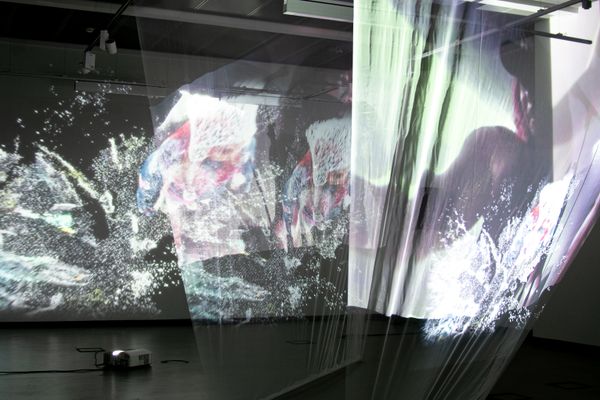
I picked an overarching topic around gender binaries in society and the political oppression of transgender rights. Within that framework I hosted a couple of events, film screenings and a workshop. In parallel I worked on an AV installation that I showed in the space.

I haven't directly developed the installation further since, but I continue to research the topic and expand on the media and methods I used. I was also able to connect with a lot of new people in Vienna, and I'm still in touch with them. There are conversations happening about future collaborations.

What has changed over the course of the residency, what process has been influenced, where has it developed or not and why?

The events I hosted gave me the chance to talk to people about my topic and understand their perspectives, the local context, and the kind of audience that would come and engage with my work. Originally I wanted to approach the topic in a much more abstract way, but I decided to make it unambiguous to get a clear message across. That led to a work that’s quite literal, almost educational. It was an interesting experiment and I’m still reflecting on what that means for my role as an artist.

Projection of Video images on various screens in a space | Image by ©Temporary studio at AIL, video installation by Jona Wolf (Photo: Jona Wolf)

What were inspiring encounters or experiences during your residency?

Coming back to Vienna – a city I have a lot of history and memories with, but also feel quite disconnected from after being away for a long time – I felt really welcomed. There was a genuine curiosity about my work that excited me and made me want to engage locally on a deeper level. I connected with a lot of people in a short time who were working on similar topics with their own tools, and I felt supported by them.

What does interdisciplinary work mean to you?

For me it’s about flexibility in techniques and a curiosity to use unfamiliar media and step into unfamiliar territory. I get bored pretty fast, which is why I like taking on new challenges. That also means learning to deal with failing and unpredictability.

Your practice moves between digital fabrication, installation, and community-based work. How does your background in architecture shape your approaches and interest and how do they come together in your artistic process?

All of these things have to do with space. I love observing and analyzing spaces. How different people activate and navigate them, the ephemeral qualities that create atmosphere, and the individual and collective memories attached to them. I think that curiosity was sparked somewhere in architecture for me and now weaves into all the different formats I work with.

As part of ‘The Palace Collective’ and other organizations in Berlin, you are deeply engaged in collaborative and activist work. How does collective organizing influence your understanding of authorship and artistic production? Your residency also became a collective and discursive space. How important are exchange, participation, and community-building within your practice?

The more I’ve facilitated opportunities and encouraged people to follow their own ideas, the more I’ve come to understand the joy in seeing people get excited about something. Whether it’s teaching at universities, facilitating workshops, or co-producing residencies – a lot of my creative energy goes into that, even if the output isn’t ‘my work.’ I’m more interested in the process itself: how we can find accessible ways to share knowledge and connect people in a way that has impact.

Being a trained architect probably helps too. Architects are used to working in large multidisciplinary teams to realize a project.

By working with technologies such as 3D animation and CNC fabrication, you engage tools often associated with precision, standardisation, or production. How do you appropriate these technologies to question normative ideas of bodies, gender, and futurity or how do they open up new perspectives on bodies, identities, and alternative futures?

These rather technical fields – 3D modeling, digital fabrication, VR – are very much dominated by a homogenous group, not necessarily a diverse crowd, who use those tools to tell their own stories. I don’t think it’s always intentional; people naturally bring their immediate reality to what they make. But being able to take up space within those environments, like at a conference, a university department, an exhibition, breaks into those same circles and exposes them to other realities, and hopefully empowers others to take up space too.

(Interview from June 2026, Questions: Elisabeth Falkensteiner, Eva Weber)

Portfolio Jona Wolf

text

Follow-Up: Suchart Wannaset

Q&A with former Alumni in Residence

Suchart Wannaset is alumni of the department of Transmedia Art and worked at AIL from February till March 2025

Within his artistic practice Suchart Wannaset explores the multi-faceted relationship between culture and nature. The shaping of natural landscapes by humans has far-reaching consequences regarding the relationship to each other as well as changes and preservation. The search for nature and so-called ‘border zones’ is an essential part of Wannaset’s artistic work. His works address social, cultural, queer and ecological phenomena, the concepts of which he implements transmedially with the help of video, sculpture, performance and photography.

During his AIL residency, Suchart Wannaset continued developing his art project Pressure, which sits at the intersection of art and science. Combining kinetic sculptures, video, and sound works, Pressure artistically explores and contributes to the little-known research on the effects of noise on insects – highlighting the harmful effects of noise and light pollution, along with habitat loss caused by suburban expansion in Vienna. In the video, the artist searches for the pure insect sounds of his childhood, only to find that much has changed. His kinetic sculptures – anthropomorphic insects – add a heavy, imposing presence, symbolizing the exhaustion imposed on these creatures and their environment by human activity. A sound database, compiled during his field recordings, documents the seemingly endless search for undisturbed natural sounds.

Dear Suchart, tell us briefly what you have been working on during your residency at AIL?

I was working on an interactive experience for a future exhibition. Visitors can scan a QR code and play sounds I recorded from the outskirts of Vienna. They can then click through my web database while walking through the exhibition with their smartphone. This adds sounds to the existing soundscape. This idea is that when we are somewhere, we leave a trace of our presence. This adds to the overall noise of that place, and makes it feel as though we are intruders there.

To create the soundscape, I was trying out the recordings and trying to use them as background noise for the exhibition.

I put all the big moth sculptures on display for the first time. I also tried out the flickering LED-Neon light in the space, which makes it more dramatic. I added the finishing touches to the textile, sewing and stitching. I can see everything that is displayed and the video that is shown at the back. This helps me to see what is missing and what I should work on or finish. The final step was taking photos and videos of the works for use later.

By combining sculpture, sound and interactive elements, your project shows how sensitive ecosystems are to change and how quickly biodiversity and natural soundscapes can be lost. In your video, you go in search of the insect sounds of your childhood, which have changed since then.

How does this personal experience shape your artistic work and your view of the relationship between memory, loss and artistic documentation?

The act of searching for the lost became an integral aspect of the artistic practice. The foundation for this artistic research was laid prior to graduation from the Angewandte Transmediale (Brigitte Kowanz) with a one-hour, three-channel video work filmed in Thailand in 2020. The title of this work is Chasing Nature into Abstraction, and it deals with the search for nature and the changing of habitats and landscapes.

The experience of being raised in Thailand at my grandparents' house, which was surrounded by lotus-filled wetlands that have since disappeared, has had a profound impact on my personal development and artistic practices.

Were there any encounters or aha experiences that inspired you during your residency? Can you briefly describe them?

Yes, this project isn't finished. The aha effect is that I can walk around every part of Vienna to make a sound database, which could be a big project in itself. The other option is to use the recordings to make new pieces of music that can also be shown as artwork on their own. People who visit my studio gave me a list of books to read and to learn more about insects and nature.

How is the project progressing now?

I added some recordings and updated some audio files to make the sound database on my website bigger. I am going to build boxes to transport the sculptures in my studio. I started cutting a video from the documentation and editing the pictures taken in the AIL studio. I did this to prepare for Open Calls and exhibition applications, as well as for my portfolio and website.

What has changed over the course of the residency, what process has been influenced?

The flickering light and the way the sound was changed added to the experience. During the residency, Nora [Mayr] introduced me to some people, including experts in the field where art and science meet. I got some ideas from the talks. It was good for my idea and I got ideas for some new artworks in the future. I found the answers to some of my questions.

One final question: What does interdisciplinary work mean to you? What significance does it have for your work?

The subjects of intersection, interdisciplinarity and the interface between art, nature and science have always been of interest to me. It is not possible to express something in one medium alone, as certain topics are very complex and can only be shown in many layers. This can be achieved through art disciplines, techniques or genres. In the context of my professional practice, the progression of one subject matter frequently gives rise to the emergence of another, thereby facilitating the exploration of diverse intellectual domains. The concept may be illustrated by means of a metaphor: that of a web which connects many dots, the benefit of which is mutual.

Born in Thailand, Suchart Wannaset moved to Vienna at the age of 7. After graduating from ‘die Graphische’ school of media and photography in 2010, he attended a photography masterclass in Paris with Oliviero Toscani in 2011. In 2014 Wannaset decided to apply to the University of Applied Arts in Vienna to study Transmedia Art after being inspired by the work of Professor Brigitte Kowanz, who was the head of the department. He graduated in 2020 with a 57-minute, 3-channel diploma film shot in his birthplace. Suchart Wannaset's collective works with the Mai Ling collective and individual works have been shown at the Secession Vienna, Brunnenpassage, Tanzquartier Vienna, Parallel, the Austrian Sculpture Park Museum Joanneum, Belveder 21 and Stadtgalerie Salzburg, among others.
text

Follow-Up: Ramiro Wong

Q&A with former Alumni in Residence

Ramiro Wong is alumni of the department of TransArts and worked at AIL from March till April 2025

Ramiro Wong’s artistic approach is interested in translation, representation and the politics of invisibilisation as an integral part and narrative of installations and performances. Both in its temporal iteration and in its object-based effects, Wong’s work is not intended to illustrate circumstances but to stimulate actions that lead to a conversation in which participants witness each other’s experiences.

Dear Ramiro, tell us briefly what you have been working on?

During the residency I was working in a new body of work which I titled Sonnet as it is intended to consist of 14 different parts which will compose an installation.

How is the project progressing now?

The project has since taken two routes, on the first I am on a research travel to find out more about the impact of that particular period of time on the people that survived the internal armed conflict in Peru and on the other hand I have been developing new pieces that can bring forward the concept.

What has changed over the course of the residency, what process has been influenced, where has it developed or not and why?

During the residency I was able to work on the physical ‘drafts’ of all the pieces at once and see how they can relate to each and create a narrative in terms of materials, illumination, dimensions, etc. 

In your work, the use of found and reused materials such as recycled car batteries is a metaphor for resilience and survival in broken systems. At the same time, the invisible plays a central role, especially in the political-social context. How do you manage to combine the material and the immaterial in your installations – or even bring them into a productive contradiction?

What interests me is precisely the tension between the visible and the invisible, the tangible object and the immaterial force it represents. A recycled car battery is heavy, toxic, and unmistakably physical, yet when connected to a light it becomes a channel for something unseen: electricity, memory, history. In my installations, this tension mirrors how political and social realities operate. Violence, fear, resilience – these are rarely visible on the surface, yet they shape how people live their everyday lives. By working with found and reused materials, I anchor the work in the real, in what you can touch and recognize. But the light they generate, the sounds that emerge, the absences they mark – these open a space for the immaterial: memory, trauma, hope. The contradiction is productive because it forces the audience to confront both dimensions at once: the material traces of survival, and the invisible systems – political, social, emotional – that are subjacent. 

What does interdisciplinary work mean to you? To what extent does it come into play in your work, why?

More than interdisciplinarity, I think of my work as transdisciplinary, meaning that at the beginning I try to create a coherent narrative by bringing in different sources of knowledge as addressed from the point of view of various disciplines but I contrast them with real experiences from the communities and peoples about whom I am talking with the intention of showcasing problems that are as contemporary as perennial and  have become invisible or ‘acceptable’ to the broader of society.

Ramiro Wong (born in Lima, Peru in 1987) is a transdisciplinary and research-based artist. His work addresses political and socio-cultural questions of identity construction. Local narratives and individual experiences serve as the starting point for what he calls dynamics of displacement: a process in which identity is formed, understood and deconstructed in different historical and geographical contexts. Wong’s current work explores how these processes have been sustained by seemingly innocuous habits of consumption, reproduction and rebranding over the course of a 500-year-old tradition that the artist calls Aesthetics of Othering.

text

Follow-Up: Verena Tscherner

Q&A with former Alumni in Residence

Verena Tscherner is alumni of the department of Digital Arts and worked at AIL from January till February 2025

Verena Tscherner experiments with the idea of the vacuum as a way to capture a moment, as a delay of decay, as ‘holding one‘s breath.' The aspects of air and vacuum are increasingly gaining new, expanded meanings in her artistic process. Inhale. deflate marked the beginning of her engagement with the genre of sculpture and spatial installation. In her diploma thesis entangle. deflate she combined 3D-printed objects with a large-scale deflateable and a sound installation. This large-scale deflateable is sculpturally placed in the space. It takes on an organic character as air is repeatedly added or removed from it using a timer.

Dear Verena, tell us briefly what you have been working on?

I produced a new installation for my exhibition at Frau* schafft Raum. I experimented with different breathing patterns of the deflateables. At the same time, I worked further with directional speakers and tried different texts, voices, atmospherical sounds and music to see how these sounds may alter the room they are placed in. I also brought my first deflateable inhale. deflate and set it up at my temporary studio at AIL.

I have been working on a lot. And maybe not much at the same time. Put a lot of effort in many different things. Finishing them all together to one new art piece: detach. deflate. Shown at Frau* schafft Raum afterwards for over three months.

How is the project progressing now?

The project is finished with the exhibition at Frau* schafft Raum. The reception of the audience was as empowering as the work itself was intended to be. It will be exhibited again this year in the LEMU (Museum Langenzersdorf, NÖ) in a group exhibition of the Bildhauer:innen Verband Österreich.

What has changed over the course of the residency, what processes has been influenced?

To imagine big installations was definitely inspired by the residency, alone because I had such a big studio space. It was nice to fill the space with all my ideas.

What does interdisciplinary work mean to you? To what extent does it come into play in your work, why?

Interdisciplinarity is a diverse form of mixing media in a honest and indeed complex way. It is more about finding the right media / or mediums for the topic and letting the artwork intuitively come to life, and see what it requests and how it may manifest itself. It’s a playful form of experimentation, that may resonate on several levels and on multiple layers with the observer.

Were there any encounters or aha experiences that inspired you during your residency? Can you briefly describe them?

Yes there were quite a few I have to say. I especially want to mention the visit from Petra Gruber from the Architecture Department of the Angewandte. I invited her for feedback on my work, as she has never seen any or my artworks so far. I was really curious to meet her and I fully enjoyed the conversation we had about so many things. I felt really inspired and it certainly opened a new perspective to me.

I also enjoyed the visits from two classes. One was my former department, the digital arts class, in the framework of a lecture held by Wolfgang Fiel. Most of the students in this group were quite young and their interest in my way of operating and creating art was truly adorable and also brought me out of my comfort zone, which is always important for any kind of progress.

Later Peter Kozek from the APL (Angewandte Performance Lab) came to visit me with some students as well. This visit was very delightful and charming at the same time. The students were really eager to learn about my work in progress of the project I created and produced during my residency at the AIL.

What happens to the idea of sculpture as a static object when – as in your case – it breathes and moves? Your sculptures deal with the topic of violence against women, i.e. a social problem that usually happens in secret within relationships. What new meanings does this create, especially with regard to empathy?

First of all, the topic is not part of my handwriting. It just happened that my first two big sculptural works dealt with a similar issue. My medium of choice, the so called Deflateables, are breathing objects, that mimic the human breathing patterns.

Therefore it appears that the audience starts to somehow interact / connect intuitively with the sculpture (object) itself and that indeed opens up a place in their consciousness that I would describe as empathy. In my opinion this brings another layer to the work and to art itself. The layer of how to engage and immerse the audience in the created atmosphere of the artwork. The layer of connecting to something more universal, yet being perceived by the individual in their own way.

Born in Tyrol, Verena Tscherner came to Vienna shortly after graduating from high school. She studied at the University of Music and Performing Arts, Vienna (MDW), where she graduated in 2014. Afterwards she studied at the Friedl Kubelka School, School for Artistic Photography in Vienna, which she graduated in 2019 with a diploma. Then she studied digital art  with Univ.-Prof. Mag.art. Ruth Schnell and UBERMORGEN at the University of Applied Arts, Vienna, and graduated in June 2024. She lives and works as a freelance artist in Vienna.